Choosing the best Ptfe Fuel Hose for 2026 is not simply a matter of selecting the highest pressure rating. Under the hood, heat rises around the fuel rail, fittings vibrate, and tight bends can strain a hose assembly. The liner, reinforcement, and end connections all matter. Small details count.
SAE International’s J30 Fuel and Oil Hoses standard offers a useful industry reference for hose performance and testing. It is not proof that every PTFE assembly meets the same requirements. Buyers should check the manufacturer’s stated test results, working-pressure limits, temperature range, and fuel compatibility. A shiny braided cover can look reassuring. It tells you little by itself.
Fuel composition deserves equal attention. The U.S. Environmental Protection Agency’s E15 fuel-registration guidance describes E15 as gasoline containing 10.5% to 15% ethanol. That variation makes it important to confirm compatibility with the fuels used in your vehicle, rather than relying on broad “fuel-safe” claims. Not automatically. For 2026, a sound comparison should weigh verified specifications, installation needs, and support from the hose maker. Product data sheets help, but they can leave practical questions unanswered, such as minimum bend radius or fitting compatibility. Those gaps deserve a closer look. The best choice is the assembly with clear evidence for your application—not the boldest packaging.
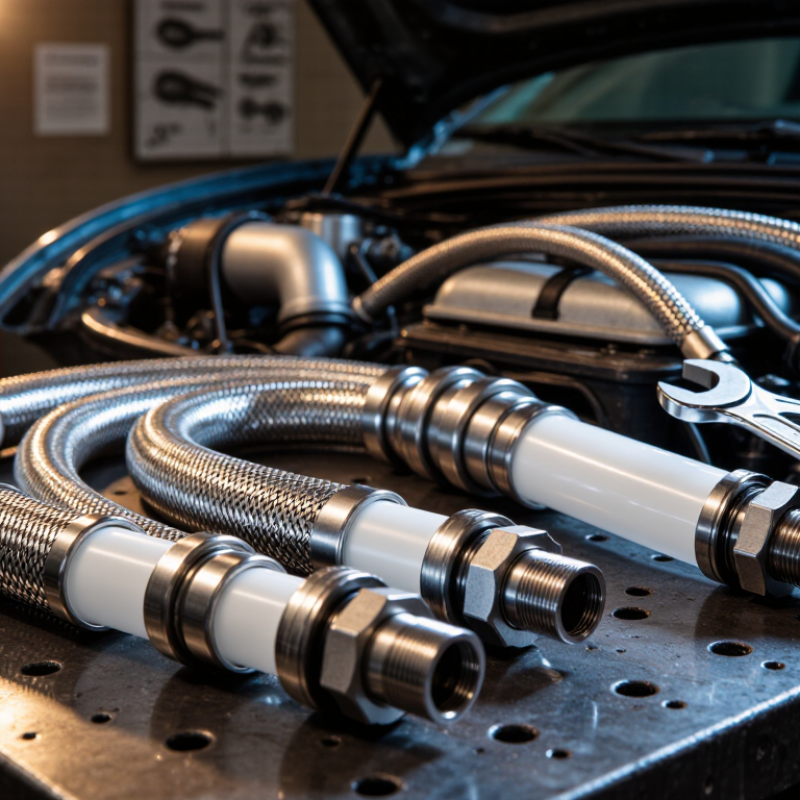
A PTFE fuel hose has a smooth fluoropolymer tube at its core. This liner carries fuel and resists many chemicals and high temperatures. Reinforcement around it, often stainless-steel braid or another specified material, helps the hose withstand pressure and resist damage. The outer layer does not determine fuel compatibility by itself. End fittings also matter: they must match the hose design and be assembled correctly. Details matter.
In service, the liner helps limit fuel permeation, while reinforcement supports the assembly under pressure. PTFE can feel less flexible than rubber hose, so tight bends may kink it or stress its connections. Check the maker’s specifications for fuel compatibility, temperature, working pressure, and minimum bend radius. A PTFE label alone does not confirm that a hose suits every vehicle or operating condition. Fit and routing need careful attention.
Choosing a PTFE fuel hose starts with the route, pressure, temperature, and fuel type—not the calendar year. Smooth-bore PTFE liners offer a clean interior that is easier to inspect and typically resists flow restriction. They suit direct, well-supported runs. Convoluted liners bend more readily around tight corners, but their ridges can make cleaning and flow less straightforward. There is no universal winner. A hose that fits neatly on a bench may kink once installed beside a hot engine component.
Reinforcement matters, too. Stainless-steel braid can protect against abrasion and support demanding applications, but it may be stiff in confined spaces. A suitable outer cover can help where the hose risks rubbing against a bracket. Check the hose maker’s pressure and temperature ratings for the complete assembly, not just the liner. Fittings must match the hose construction and connection type. A mismatched fitting can leak, even when both parts appear well made. Take time here.
Tips: Measure the installed route, including bends and movement. Keep the hose clear of sharp edges and heat sources, and follow the fitting maker’s assembly instructions. After installation, inspect for twisting, chafing, and seepage. Small details are easy to miss, and inspection intervals should reflect the operating conditions.
Evaluating Fuel Compatibility, Pressure, and Temperature Ratings
Choosing PTFE fuel hose starts with the actual fuel, not the word “compatible.” PTFE resists many hydrocarbon fuels and alcohol blends, but additives, exposure time, and hose construction still matter. SAE J30 provides fuel-hose performance requirements, while ASTM D471 describes methods for assessing material changes after liquid exposure. Ask for test results covering the fuel blend you use, not just a general compatibility chart. A small but important distinction.
Pressure ratings belong to the complete hose assembly. A liner’s strength does not establish the rating of its braid, fittings, or assembled connections. Check the manufacturer’s working-pressure rating at your operating temperature, and ask whether it accounts for pressure pulses and installation bends. Published fluoropolymer technical data commonly place PTFE’s continuous-use temperature near 260°C. That figure describes the material, not every finished hose. The braid and fittings may set a lower limit.
Inspect the temperature range alongside the pressure rating; heat can reduce an assembly’s safe pressure capacity. SAE J30 and ISO 7840 offer useful benchmarks for fuel-hose performance, but neither replaces the specific assembly data sheet. Look for documented fuel exposure, temperature derating, and pressure-test conditions. I would not choose by maximum pressure alone. It is easy to overlook routing near a hot engine part, especially when the hose feels cool during a brief inspection.
Choosing a PTFE fuel hose starts with your vehicle’s requirements, not the product photo. Check the fuel type, operating temperature, and maximum system pressure. The hose’s working-pressure rating should safely exceed the system’s demands. Match its internal diameter to the required fuel flow; a larger hose is not automatically better.
Check the details.
Look for a hose and fittings specifically designed to work together. Some PTFE hose assemblies require a conductive inner liner, so verify the manufacturer’s specifications rather than assuming every PTFE hose suits every fuel system.
Routing matters, too. Measure the path, allow for engine movement, and keep the hose clear of sharp edges, hot exhaust parts, and tight bends. A neat installation can still be wrong if it kinks under movement.
It is easy to focus on the braid and overlook the fittings. I would double-check their compatibility and assembly instructions before installation.
After fitting, inspect for leaks using the vehicle’s specified test procedure. Appearance alone tells you very little.
When choosing the best PTFE fuel hose in 2026, check the complete assembly, not just its liner. PTFE can tolerate a wide temperature range, but the hose’s actual limits depend on its braid, fittings, and construction. Ask for published working and burst pressures at the temperatures you expect. A pressure figure without a temperature condition is incomplete. SAE J30 offers useful fuel-hose test context, but it does not automatically certify a PTFE assembly. ASTM D4894 evaluates PTFE resin properties, not the finished hose. Small distinction. It matters.
Look for permeation data, bend-radius limits, and evidence of pressure-impulse testing. The U.S. EPA’s 40 CFR Part 1060 measures fuel-line permeation in grams per square meter per day; its requirements apply to specific equipment categories, not every vehicle or hose. Treat that test method as a comparison tool, not a universal pass mark. Check that the stated results match the fuel type, temperature, and fittings in your application. Tight bends near a hot engine can stress the line even when its pressure rating looks ample. A common mistake is focusing on maximum pressure alone. Ask for the test conditions and inspect the hose after installation. A datasheet can’t show every routing problem.
