Choosing the best PVD Coating Equipment in 2026 is less about buying the largest chamber and more about matching the system to the part. A toolmaker coating small carbide inserts has different needs from a manufacturer processing automotive components. Batch size, substrate temperature, coating uniformity, cycle time, and maintenance access all affect the decision. Small details matter. A crowded fixture, for example, can leave shadowed surfaces even when the coating recipe looks sound.
Market reports offer useful context, but they need careful reading. Grand View Research estimated the global physical vapor deposition market at approximately USD 23.4 billion in 2023 and projected a 7.4% compound annual growth rate from 2024 to 2030. That figure covers a broad market, not equipment sales alone. It signals continued investment in PVD applications, but it cannot identify the right machine for a specific factory. A forecast is not a buying specification.
This guide compares equipment types, process capabilities, operating costs, and supplier support using practical selection criteria. It also considers what published data can—and cannot—tell buyers. No single system is best for every workload. A high-throughput platform may be excessive for short production runs; a lower-cost unit may become costly if uptime or coating consistency suffers. Those trade-offs deserve scrutiny, and the available evidence does not always make them easy to judge.
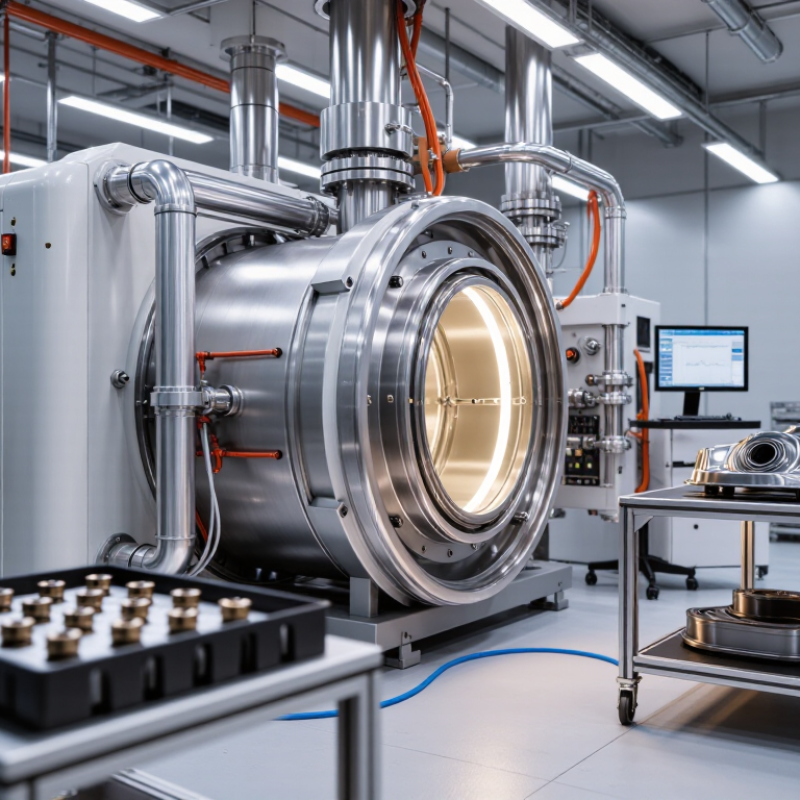
PVD coating equipment turns solid material into a thin film without using a liquid coating bath. Inside a vacuum chamber, a source material is heated or bombarded with energetic ions until atoms leave its surface. Those atoms travel through the chamber and settle on a cleaned component, forming a tightly bonded layer. Common systems use evaporation or magnetron sputtering; the right method depends on the coating material, part shape, and required film properties. A watch case, cutting tool, and semiconductor wafer do not need the same recipe.
The equipment usually includes a vacuum pump, coating source, gas controls, power supply, and fixtures that hold and rotate parts. Operators monitor pressure, temperature, and deposition time because small changes can affect color, hardness, or film uniformity. Applications range from wear-resistant tool coatings to decorative finishes and thin functional layers in electronics. The Semiconductor Industry Association reported global semiconductor sales of $627.6 billion in 2024, underlining the scale of one sector that relies on thin-film processes. Grand View Research estimated the broader global PVD market at $21.7 billion in 2022; that figure covers more than equipment alone. The number is useful, but not a buying guide. A chamber that works well for flat samples may coat recessed edges unevenly, and I have seen teams underestimate fixture design. It matters.
How operating pressure differs across common PVD processes
How it works: PVD equipment vaporizes a solid coating material in a vacuum; the vapor then travels to and condenses on a component’s surface. Sputtering ejects atoms from a target using plasma, evaporation heats the source, and cathodic arc uses an electrical arc to generate metal ions.
Choosing equipment: There is no single best system for every job. Sputtering is widely used for uniform, controllable films; evaporation suits many thin-film applications; cathodic arc is used for dense, hard coatings. The pressure ranges shown are indicative process windows—not equipment specifications—and vary with materials, gases, and process settings.
Choosing PVD equipment starts with the coating mechanism, not a headline specification. Magnetron sputtering suits thin, uniform films on complex production runs, but demands stable gas flow, target power, and well-designed fixtures. HiPIMS adds high-power pulses and greater metal-ionization potential; the power supply and thermal management must handle those pulses reliably. Arc ion plating delivers strongly ionized material, while droplets can affect surface finish. Filtration and substrate motion matter. E-beam evaporation is useful for line-of-sight films, but recessed features may receive less coverage. Vacuum stability matters. So does maintenance access.
A 2024 Grand View Research report valued the global PVD market at USD 22.15 billion in 2023 and projected 6.3% annual growth through 2030. This is a broad market estimate, not an equipment-sales figure, but it signals growing demand across applications. For a real purchase, compare usable chamber volume, batch size, uniformity data, and changeover time under your own substrate conditions. Ask for coating results on parts shaped like yours, not only flat test coupons. That test is less glamorous. It is often more revealing. No single technology wins every job; even a carefully written specification can miss awkward loading patterns or small temperature differences.
Which PVD Coating Equipment Is Best in 2026?
Criteria for Comparing PVD Coating Systems in 2026
The best system is the one that meets your coating specification on your actual parts—not the one with the fastest brochure rate. Compare thickness uniformity across a fully loaded chamber, adhesion, deposition rate, and repeatability between runs. Ask suppliers to coat representative parts, including recessed surfaces and sharp edges. Measure the results at several points, not just the easiest surface. Small details matter.
MarketsandMarkets’ Physical Vapor Deposition Market report projected growth from USD 22.5 billion in 2023 to USD 33.7 billion by 2028. That forecast signals expanding demand, but it does not identify the right equipment for a specific factory. Compare usable output per shift, changeover time, maintenance intervals, energy use, and the system’s temperature limits for your substrates. Request cycle-time and yield data under comparable test conditions. A faster deposition rate can still mean lower output if cleaning or rework takes longer. No system wins every test. Vendor trial data may not match your parts perfectly, either, so leave room for a cautious pilot run before committing.
The best PVD system in 2026 depends less on a ranking than on the coating job. For cutting tools, cathodic arc systems can deposit hard nitride films quickly and support demanding production volumes. Their trade-off is droplets, which may roughen surfaces where a smooth finish matters. Fit matters more.
Magnetron sputtering suits optical, electronic, and precision parts that need uniform, controllable layers. A fixture can rotate lenses or small components through the plasma, helping reduce thickness variation across a batch. The process may be slower than arc deposition, and reactive gas control needs close attention. Small changes matter. High-power impulse magnetron sputtering can produce dense, adherent films, though equipment costs and process tuning can be substantial.
Thermal or electron-beam evaporation remains useful for decorative coatings and some optical stacks when line-of-sight deposition is acceptable. Complex shapes can shadow one another; a polished front face may hide thin coverage around edges. Inline systems reduce handling time, while batch chambers accommodate varied part sizes. Neither choice is automatically better. That shortcut can mislead. Compare substrate temperature limits, film thickness, part geometry, and acceptable defect levels, then test representative parts rather than relying only on flat coupons.
| Equipment Type | How It Deposits the Coating | Best-Suited Applications | Key Advantages | Main Considerations | Typical Coating Examples |
|---|---|---|---|---|---|
| Cathodic Arc Evaporation | An electric arc vaporizes material from a solid cathode in a vacuum chamber; reactive gases can be added to form compound coatings. | Cutting tools, forming tools, wear-resistant components, and applications requiring dense, hard coatings. | High ionization of the coating material; supports high deposition rates and strong coating adhesion on properly prepared parts. | Arc-generated macroparticles can create surface droplets. Filtering, process tuning, or post-treatment may be needed when a very smooth finish is required. | TiN, TiAlN, CrN, and related nitride coatings. |
| Magnetron Sputtering | Plasma ions dislodge atoms from a target; magnetic fields help sustain the plasma near the target surface. | Decorative and functional coatings, optical layers, electronics, large-area substrates, and parts where smooth films are important. | Produces relatively smooth, uniform films and can coat a range of materials. Multiple targets can be used for multilayer or alloy coatings. | Deposition rates and coating properties depend on target material, power mode, chamber layout, and substrate geometry. Complex parts may need rotation or dedicated fixtures. | Metal films, oxide and nitride films, and multilayer optical or functional coatings. |
| HiPIMS Sputtering | A pulsed magnetron process applies high-power pulses to create a highly ionized sputtered-material flux. | Applications prioritizing dense films, improved adhesion, and coverage of detailed components, including advanced tooling and precision parts. | High ionization can improve film density and enable energetic deposition with control over process conditions. | Equipment and process control are more complex than conventional sputtering. Average deposition rate and cost-effectiveness depend on the specific process and coating target. | Dense metal, nitride, and multilayer coatings, including selected hard-coating systems. |
| Electron-Beam Evaporation | A focused electron beam heats and evaporates source material; the vapor condenses on substrates in a vacuum. | Optical coatings, reflective layers, and applications using materials that can be evaporated under controlled conditions. | Can provide high-purity films and is well suited to sequential layer deposition in optical coating systems. | Line-of-sight deposition can limit coverage on complex shapes. Material choice, source stability, and substrate heating require careful process design. | Metal films and multilayer dielectric or optical coatings. |
| Ion Plating | Evaporated or sputtered coating material is ionized, while the substrate is biased to attract energetic ions during deposition. | Decorative hardware, tools, and components where adhesion and coverage on shaped surfaces are important. | Ion bombardment can help clean and activate surfaces and promote dense, adherent coatings when the process is properly matched to the substrate. | Substrate bias and ion energy must be controlled to avoid excessive heating or damage. Coverage still depends on part geometry and fixture design. | TiN, CrN, and other metallic or compound coatings. |
| Reactive PVD System | A PVD source deposits metal while a reactive gas, commonly nitrogen or oxygen, forms a compound film at the substrate or in the plasma. | Hard coatings, colored finishes, and functional nitride or oxide films across tooling and manufactured components. | Enables compound coatings using metallic targets and reactive gases; recipe control can support a range of film compositions. | Reactive-gas flow and target condition must be controlled to maintain stable deposition and consistent film composition. | Nitrides such as TiN and CrN; oxides such as selected transparent or functional films. |
Selection note: The best system depends on coating material, part geometry, required film properties, production volume, substrate limits, and available process expertise. Equipment capabilities and results vary by chamber design and process configuration.
The best PVD system depends on the parts you coat, not the size of its specification sheet. Start with the largest component, the required coating thickness, and your weekly batch volume. A chamber that fits one sample may not fit production fixtures. That detail matters.
Choose the process around the coating and substrate. Magnetron sputtering can suit uniform films and varied materials; arc evaporation can support hard coatings on tools. Check maximum substrate temperature, fixture rotation, target compatibility, and vacuum pump-down time.
Ask suppliers to coat representative parts, then inspect thickness variation, adhesion, and surface finish. Request cycle-time estimates that include loading, heating, cooling, and cleaning. Compare service access and consumable costs, too. A low purchase price can hide expensive downtime. I would leave capacity headroom, but not pay for unused chamber volume. Small batches change the math.
