China’s industrial robot sector has grown into a broad ecosystem, serving automotive plants, electronics lines, logistics centers, and smaller factories. The country’s manufacturers differ in more than price. Their strengths may include payload capacity, motion accuracy, software integration, service coverage, or experience with demanding production environments. For buyers, the details matter: a robot’s reach, cycle time, controller, and available support can shape a project’s real cost.
Joseph Engelberger, a pioneer of industrial robotics, is often quoted as saying, “I can’t define a robot, but I know one when I see one.” His observation captures a practical truth: specifications alone do not tell the whole story. A machine must work reliably beside operators, fit the production layout, and remain supportable after installation. That matters.
This overview introduces ten notable industrial robot manufacturers in China and the capabilities that distinguish them. It considers product range, application focus, technical development, and market presence rather than treating a single metric as decisive. Company offerings and service networks can change, so readers should confirm current specifications directly with each manufacturer. No ranking is perfect. A supplier that suits a welding cell may not suit delicate assembly, and public information can leave gaps. Use this list as a starting point for comparison, then assess each candidate against your process, facility, and support requirements.
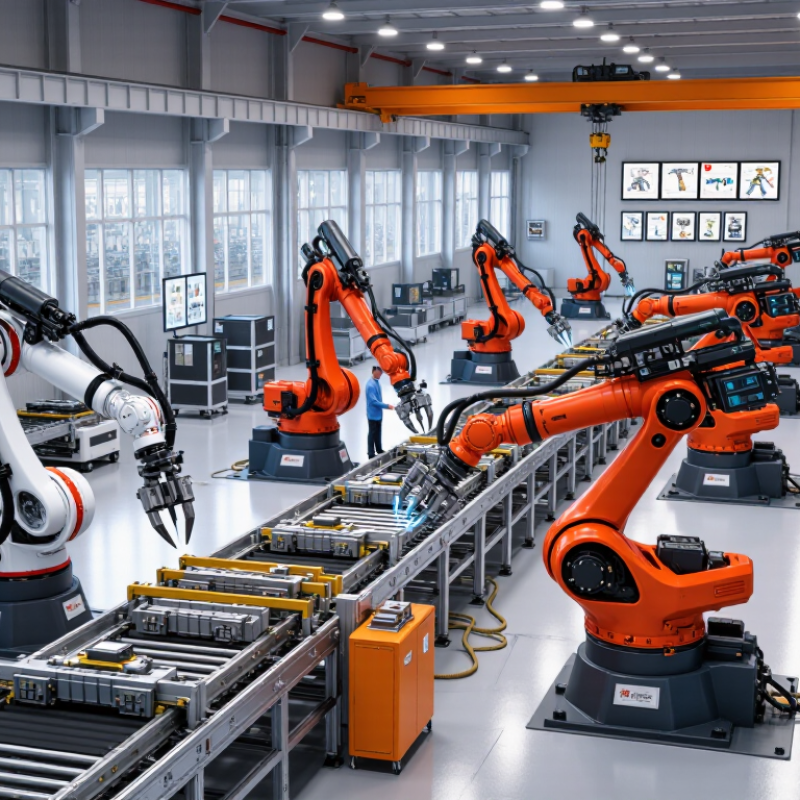
China’s industrial robot manufacturing sector is broader than the production of robot arms. It includes controllers, motors, sensors, software, and integration services. Domestic manufacturing has grown, but capability and maturity still vary across product types. A robot’s performance depends on its control system and setup, not just its mechanical reach.
For buyers, compare payload, reach, repeatability, cycle time, safety interfaces, and service response. A welding cell and an electronics assembly line have different requirements. Ask how specifications were tested and whether replacement parts are readily available. Published cycle times may not match a real production line, where tooling, operator flow, and workpiece variation all matter. That detail is easy to miss.
Tips: Request a sample-cell trial using your actual workpieces. Confirm who handles installation, training, maintenance, and software updates. Check the service plan in writing. A short demonstration can reveal much, but it cannot prove long-term reliability. Some evaluation work is imperfect; record what remains untested before making a decision.
China’s industrial robot market is large, but scale alone does not identify a leading manufacturer. The International Federation of Robotics’ World Robotics 2024 report recorded 276,288 robot installations in China in 2023, around 51% of global installations. Its reported operational stock was about 1.8 million units. These figures show market depth, not product quality. Look for verifiable data on payload, reach, repeatability, cycle time, and uptime under comparable operating conditions. Details matter: a robot handling a hot casting faces different demands from one placing small parts on a fast assembly line. Test the application, not just the brochure.
Service quality deserves equal weight. Check spare-parts availability, technician coverage, training, and documented response times. Review safety documentation and integration requirements, then ask for references from similar production environments. Total cost should include commissioning, maintenance, energy use, and downtime—not only the purchase price. A useful comparison uses the same task, shift length, and acceptance criteria for every candidate. Be cautious with headline performance claims; public reports rarely compare manufacturers using identical tests. That gap is worth admitting. A precise ranking can look authoritative while hiding differences in workload, configuration, and after-sales support.
China’s industrial robot manufacturers serve different production needs, from compact assembly cells to heavy material handling. The ten profiles below focus on practical capabilities rather than brand claims. One maker specializes in six-axis robots for welding. Another builds SCARA units for fast, repeated assembly. A third focuses on palletizing arms for warehouses and factories. A fourth develops collaborative robots for smaller workspaces. A fifth supplies robotic systems for machine tending.
A sixth manufacturer concentrates on painting applications, where stable motion matters. A seventh designs delta robots for lightweight picking and sorting. An eighth makes heavy-payload arms for automotive production lines. A ninth combines robot hardware with vision and control software. A tenth provides customized automation cells for mixed production tasks. These profiles are broad guides, not a performance ranking. Real capability varies by model, integration quality, and service support. A polished catalogue can hide integration limits; that deserves a closer look.
Tips: Compare payload, reach, repeatability, and cycle time against your actual workpiece. Ask for a sample-cell test using your parts. Check spare-part availability and local service response, too. A low purchase price may not mean lower operating cost.
Anonymized company profiles. The profile numbers are for reference only and do not indicate market-share ranking. Product focus and applications are summarized at a high level.
| Profile | Main Product Focus | Common Robot Types | Typical Applications | Core Strengths | Market Orientation |
|---|---|---|---|---|---|
| Profile 1 | Industrial robots and factory automation equipment | Articulated robots; SCARA robots | Automotive production, welding, material handling, and general manufacturing | Combines robot systems with broader industrial automation products and manufacturing solutions | Domestic and international industrial customers |
| Profile 2 | Industrial robotics, mobile robotics, and automated production systems | Articulated robots; mobile robots; specialized automation equipment | Automotive, logistics, electronics, and factory automation | Broad robotics portfolio with capabilities in both standalone equipment and integrated systems | Large-scale industrial projects and smart-manufacturing deployments |
| Profile 3 | Industrial robots and intelligent manufacturing solutions | Articulated robots; welding and handling robots | Automotive manufacturing, metal fabrication, welding, and material handling | Focuses on industrial robot production and application engineering for automated work cells | Industrial manufacturers and automation integrators |
| Profile 4 | Industrial robots alongside CNC and factory automation products | Articulated robots; SCARA robots; welding robots | Machining, welding, loading and unloading, and general factory automation | Offers robotics within a wider portfolio of manufacturing-control and automation technologies | Machine-tool, metalworking, and general manufacturing sectors |
| Profile 5 | Industrial automation products and industrial robotics | Articulated robots; SCARA robots | Electronics, packaging, material handling, and automated production lines | Connects robot deployments with drives, motion control, and other factory automation equipment | Factories seeking coordinated automation components and systems |
| Profile 6 | Collaborative robots and supporting automation solutions | Collaborative robotic arms | Machine tending, assembly, inspection, and flexible handling tasks | Emphasizes human-robot collaboration and flexible deployment in production environments | Manufacturers and integrators adopting adaptable robotic work cells |
| Profile 7 | Collaborative robots and industrial automation applications | Collaborative robotic arms | Assembly, packaging, machine tending, and material handling | Provides collaborative robot products intended for use in varied production tasks | Small and medium-sized manufacturers as well as larger industrial users |
| Profile 8 | Industrial robot arms and application-oriented automation | Articulated robots; SCARA robots; welding and handling robots | Welding, palletizing, loading and unloading, and general manufacturing | Offers multiple robot configurations for common industrial processes | Industrial facilities and automation system integrators |
| Profile 9 | Industrial robots and automated manufacturing systems | Articulated robots; welding robots | Automotive production, welding, and automated assembly | Combines industrial robot products with project-based automation and production-line applications | Automotive and other process-intensive manufacturing industries |
| Profile 10 | Collaborative robots and compact robotic automation products | Collaborative robotic arms; compact robot platforms | Education and research, assembly, handling, and selected industrial automation tasks | Serves both entry-level robotics use and production applications requiring compact, flexible systems | Education, research, integrators, and industrial users |
Top 10 Industrial Robot Manufacturers in China: Key Robot Types, Technologies, and Applications
China’s industrial robot makers supply several common designs, each suited to different tasks. Articulated robots handle welding, machine tending, and palletizing with flexible reach. SCARA robots suit fast, precise assembly, while delta robots are often used for lightweight picking and sorting. Collaborative robots can work near people when the cell is properly designed and assessed. Fit matters. Payload, reach, cycle time, and floor space should guide selection—not headline speed alone.
The technology behind these machines includes motion controllers, servo drives, encoders, and machine-vision systems. Cameras can locate parts on a moving conveyor; force sensors help detect contact during delicate assembly. These features are useful, but they do not remove the need for calibration, stable lighting, and clear process limits. A camera may struggle with glare. Small details can stop a line.
Applications span automotive production, electronics, metalworking, packaging, and logistics. A robot may weld a body panel, place components on a circuit board, or move cartons between stations. Mobile robots add transport between work cells, though route planning and charging need practical attention. Integration is often the harder part: fixtures, software, operator training, and maintenance all affect performance. Even a capable robot can disappoint when the surrounding process is poorly prepared.
Top 10 Industrial Robot Manufacturers in China
Comparing ten manufacturers by products and market position means looking beyond headline rankings. Product portfolios can range from compact pick-and-place arms to heavy-duty welding, painting, and palletizing robots. Some suppliers focus on a few applications, while others offer controllers, grippers, and integration support alongside robot arms. That breadth matters when a factory needs equipment that works with existing production lines. The strongest fit depends on the task, payload, reach, cycle time, and available service—not just the number of models in a catalog.
Tips: Compare specifications on the same task. Check payload at full reach, not only the maximum figure. Ask about spare-part availability and technician response times. A factory visit or sample-cell test can reveal details brochures miss. Small details matter.
Market position is also shaped by customer base, delivery capacity, and experience in specific industries. A supplier with deep local support may suit a plant that needs fast maintenance; an export-focused manufacturer may offer broader documentation and overseas service. These differences are not always easy to verify. A polished catalog can still hide limited integration experience, and I would treat unverified performance claims cautiously. Request references for similar installations, review acceptance-test criteria, and compare total ownership costs, including training and downtime. The best choice is rarely the one with the most impressive product list.
Annual installations provide context for the scale and development of the market in which industrial robot manufacturers compete.
Source: International Federation of Robotics (IFR), World Robotics reports. Figures represent annual installations in China, not manufacturer rankings or market shares.