Top Palletizing Robot Cost Guide for Global Buyers

Buying a palletizing robot is rarely a simple equipment purchase. The palletizing robot cost may include the robot arm, gripper, conveyor, safety fencing, programming, installation, training, and future maintenance. A quotation showing only the robot price can look attractive, yet hide several essential expenses. Details matter.

This guide helps global buyers build a more realistic budget before requesting supplier offers. It examines robot payload, reach, pallet patterns, cycle speed, product dimensions, and working hours. A 25-kilogram carton moving every few seconds needs a different solution from a light bag handled occasionally. Site conditions also affect the budget. Floor space, power supply, local labor, shipping distance, and commissioning support can change the final figure.

The estimates discussed here reflect common industry practices and supplier quotation structures. They are useful for comparison, not a guaranteed purchase price. Experienced integrators may recommend different layouts for the same production target. That difference deserves careful review. Buyers should request an itemized quotation, clarify warranty coverage, and confirm whether software licenses and spare parts are included. Ask about changeover time, too. It is often overlooked.

A reliable cost decision connects price with measurable production value. Consider labor savings, uptime, maintenance access, product damage, and expected service life. Payback calculations can be helpful, but they depend on real operating data. Some assumptions may be imperfect. Recheck them with plant records and independent technical advice before approving the project.
Top Palletizing Robot Cost Guide for Global Buyers

Palletizing Robot Types and Their Typical Cost Ranges

Palletizing Robot Types and Their Typical Cost Ranges

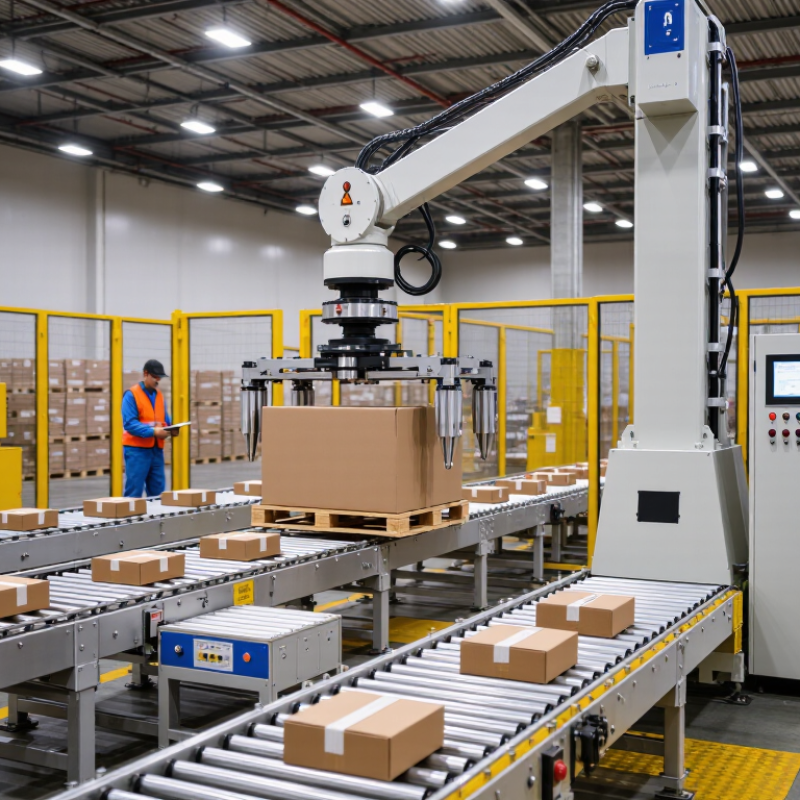
Palletizing robots vary by payload, reach, speed, and end-of-arm tooling. Articulated robots usually cost about $45,000–$120,000 for the robot alone. A complete palletizing cell may reach $100,000–$250,000 after conveyors, guarding, programming, and integration. Collaborative palletizing systems often range from $25,000–$70,000, but their lower speed can reduce savings in high-volume plants. Layer-forming machines may cost $80,000–$180,000 and suit repetitive cases with stable dimensions.

The International Federation of Robotics reported 541,302 industrial robot installations worldwide in 2023. Asia represented about 70% of new installations, according to World Robotics 2024. This expanding installed base supports stronger service networks, yet regional labor and commissioning costs remain uneven. A 2024 Interact Analysis market review also identified logistics and material handling as important growth areas for robotics. However, published price ranges can mislead. A dusty warehouse, mixed carton sizes, or weak floor foundations may add $20,000–$60,000.

Tips: Request a cell-level quotation, not only a robot price. Specify boxes per minute, payload, pallet patterns, shift hours, and changeover time. Include grippers, safety scanners, software, training, spare parts, and acceptance testing. Ask for three-year operating costs. Cheap equipment may become expensive during unplanned stops. My practical view is less comfortable: many buyers overestimate robot speed and underestimate integration work. Verify the layout with real cartons before signing.
Key Factors That Determine Palletizing Robot Prices

Palletizing robot prices vary widely because the machine is only one part of the buying decision. Payload capacity, arm reach, cycle speed, and operating hours strongly influence the base cost. A robot handling 25-kilogram cartons needs different mechanics than one moving lightweight bags. Faster production also requires stronger motors, tighter control, and better cooling.

End-of-arm tooling can change the quotation quickly. Vacuum grippers, clamp tools, and multi-zone designs suit different carton surfaces and pallet patterns. Controls, sensors, guarding, pallet conveyors, and safety scanners add further expenses. Integration work is often underestimated. Floor space, existing conveyor height, carton variation, and software communication can create unexpected engineering tasks.

In factory evaluations, I have seen low initial quotes become expensive after installation. A cheaper system may lack tool flexibility or reliable changeover functions. That does not make every premium option necessary. Buyers should request a detailed cost breakdown, including installation, training, spare parts, maintenance, and projected energy use. Local service capability also matters when production stops at night. Performance trials should test real cartons, actual pallet sizes, and the required operating rhythm. The perfect simulation is rarely perfect on the factory floor.

Top Palletizing Robot Cost Guide for Global Buyers - Key Factors That Determine Palletizing Robot Prices

Robot Configuration Typical Payload Typical Reach Typical Throughput Indicative Robot-Only Price Typical Complete Cell Investment Main Cost Drivers
Collaborative palletizing robot 10–20 kg 1,300–1,800 mm Up to approximately 8–15 cases per minute, depending on load and pattern US$25,000–$55,000 US$45,000–$100,000 Payload, reach, gripper type, safety scanners, pallet dispensing, and software features
Compact four-axis palletizing robot 80–165 kg 2,000–3,200 mm Approximately 15–35 cases per minute US$45,000–$90,000 US$90,000–$180,000 Cycle time, maximum wrist load, conveyor speed, layer formation, and end-of-arm tooling
High-speed four-axis palletizing robot 120–300 kg 2,400–3,800 mm Approximately 25–60 cases per minute US$70,000–$140,000 US$150,000–$300,000 High-speed motion control, product spacing, multi-pick tooling, guarding, and line integration
Six-axis industrial palletizing robot 50–250 kg 2,000–3,500 mm Approximately 10–35 cases per minute US$55,000–$130,000 US$120,000–$260,000 Additional axes, motion flexibility, reach envelope, vision requirements, and safety-rated controls
Bag, sack, or irregular-product palletizing cell 80–200 kg 2,000–3,200 mm Approximately 8–25 bags or sacks per minute US$60,000–$125,000 US$140,000–$300,000 Product deformation, bag stabilization, vacuum or clamp tooling, layer squaring, and slip-sheet handling
Vision-guided mixed-SKU palletizing cell 20–150 kg 1,800–3,000 mm Approximately 6–20 cases per minute US$70,000–$160,000 US$160,000–$350,000 3D or 2D vision, SKU recognition, variable case dimensions, recipe management, and warehouse-system communication
Cost interpretation: The figures above are indicative global market ranges in United States dollars for new equipment. A complete palletizing cell may include the robot, controller, gripper, infeed and discharge conveyors, pallet magazine, slip-sheet unit, guarding, safety controls, programming, installation, and commissioning. Freight, import duties, local electrical work, building modifications, taxes, and long-term service contracts are generally excluded.
Price Factor Typical Specification Range Indicative Cost Effect How It Influences the Final Price
Payload capacity 10 kg to 300 kg or more High Higher payload ratings require stronger motors, mechanical components, foundations, and larger end-of-arm tooling.
Robot reach 1,300–3,800 mm Medium to high Longer reach can reduce conveyor changes but normally increases robot size, footprint, guarding, and structural requirements.
Required throughput 6–60 cases or bags per minute High Higher output may require faster robots, dual-pick grippers, additional conveyors, product accumulation, and optimized controls.
Product dimensions and weight Variable cases, cartons, bags, trays, or containers Medium to high Wide variation in product size or center of gravity can require adjustable tooling, sensors, recipes, and additional testing.
End-of-arm tooling Vacuum, clamp, fork, magnetic, or hybrid gripper US$5,000–$35,000+ Tooling cost depends on load, surface condition, number of products picked at once, changeover needs, and customization.
Pallet pattern complexity Single-SKU to multi-pattern or mixed-SKU layouts Medium Complex patterns increase programming, recipe-management, vision, validation, and changeover requirements.
Pallet and slip-sheet handling Manual pallet placement to fully automatic feeding US$15,000–$70,000+ Automatic pallet dispensers, slip-sheet applicators, pallet conveyors, and layer handling add equipment and controls cost.
Safety system Fencing, doors, scanners, light curtains, or collaborative monitoring US$8,000–$40,000+ Required safeguards depend on robot speed, access points, risk assessment, local regulations, and cell layout.
Vision and inspection None, 2D position detection, or 3D recognition US$10,000–$60,000+ Vision hardware, lighting, image-processing software, integration, and application validation increase system cost.
Controls and factory integration Standalone cell to MES, WMS, or line-wide communication US$10,000–$75,000+ PLC programming, industrial networking, data exchange, production tracking, and recipe synchronization add engineering hours.
Installation and commissioning Local setup to international turnkey deployment 10%–25% of equipment value Travel, site preparation, mechanical and electrical installation, operator training, testing, and production ramp-up affect the total budget.
Service and spare parts Basic support to full preventive-maintenance coverage 3%–10% annually Annual operating cost depends on response time, remote support, spare-parts inventory, preventive maintenance, and software coverage.
Planning benchmark: For most standard single-SKU case-palletizing projects, buyers should budget approximately US$90,000–$180,000 for a basic integrated cell and approximately US$180,000–$350,000 for a higher-speed, multi-format, or vision-enabled system.

Equipment, Integration, and Installation Costs Explained

Top Palletizing Robot Cost Guide for Global Buyers

Equipment, Integration, and Installation Costs Explained

A palletizing robot project rarely costs only the robot arm. Equipment packages may include the gripper, conveyor, safety fencing, pallet dispenser, sensors, and control cabinet. For a medium-duty line, these items can represent a substantial share of the budget. A simple vacuum gripper may reduce handling costs, while mixed carton sizes often require a more adaptable and expensive tool.

Integration creates the largest cost variation. Engineers must connect the robot with conveyors, barcode systems, warehouse software, and existing packaging equipment. Programming fees usually reflect product patterns, pallet heights, changeover speed, and safety testing. A line handling one stable carton size is easier to configure. It is not always cheaper in the long run. Limited flexibility can create costly production pauses later.

Installation costs include mechanical assembly, electrical wiring, factory acceptance testing, transport, and on-site commissioning. Overseas projects may also require travel, local technicians, translation, and spare parts storage.

Site conditions matter. Uneven floors, restricted access, or insufficient power can add unexpected work. Measure these details before requesting a final quotation.

A practical budget should separate equipment, integration, installation, training, and maintenance. Ask suppliers to define exclusions clearly. Some quotations appear attractive because programming or safety equipment is missing. That can be misleading.

I have seen projects underestimate changeover testing. The line worked, but production teams needed more training than expected. Allowing a contingency of roughly 10% to 20% is sensible, though complex facilities may require more.

Regional Pricing Differences for Global Buyers

Palletizing robot costs can change sharply by region, even when the robot specification remains similar. Labor rates, freight distance, import duties, and local electrical standards affect the final investment. A system installed near a major manufacturing hub may cost less because integrators and spare parts are easier to access. Remote sites often require added travel, training, and service time.

Regional labor economics matter greatly. In high-wage markets, automation may deliver faster payback by replacing repetitive manual handling. In lower-wage regions, the business case may depend more on safety, output consistency, and labor availability. Installation conditions also matter. A clean, prepared floor reduces commissioning work. An uneven surface or limited power capacity can create unexpected expenses. My early estimates were too optimistic because I ignored these site details.

Tips:

Request a landed-cost estimate, not only an equipment price. Ask for separate figures covering freight, customs, integration, safety equipment, training, and annual maintenance. Compare at least three local installation proposals. Check whether replacement parts are stocked regionally. Currency movement can also change the budget before delivery. Leave a contingency allowance; real projects rarely follow the first spreadsheet perfectly. After-sales response should be measured in hours, not vague promises.

How to Compare Total Ownership Costs and Supplier Quotes

Top Palletizing Robot Cost Guide for Global Buyers

Comparing palletizing robot quotes requires more than reading the equipment price. A complete estimate should include the robot, gripper, conveyors, guarding, programming, installation, training, spare parts, and production testing. The International Federation of Robotics reported 541,302 industrial robot installations worldwide in 2023. This confirms growing adoption, but it does not guarantee a suitable return for every warehouse.

Total ownership cost also includes electricity, planned maintenance, software support, downtime, and operator retraining. Ask suppliers to separate one-time costs from annual expenses. Request assumptions for cartons per minute, product weight, working shifts, and expected availability. A quote promising 99% uptime may exclude changeover delays or manual recovery. My first estimate was too optimistic because it ignored pallet pattern changes. Real operations are messier. That mistake still matters.

Tips: Compare suppliers using the same five-year model. Include labor savings, rejected cases, energy use, and emergency service travel. Check whether spare parts are locally available. The IFR World Robotics 2024 report lists more than 4.28 million industrial robots operating globally, yet system quality varies by application. Visit a reference site if possible. Watch an actual shift, not only a demonstration. A neat spreadsheet can still be wrong. Recheck every assumption with production and maintenance teams.

Top Palletizing Robot Cost Guide for Global Buyers

Five-year total ownership cost comparison by palletizing cell complexity

The comparison includes typical planning-budget categories for an industrial palletizing cell: robot and cell hardware, integration, end-of-arm tooling, safety equipment, installation and training, maintenance, energy, and downtime contingency. Values are indicative global-market estimates in USD thousands and should be validated against actual site requirements and supplier quotations.